Market Microstructure and Algorithmic Power Dynamics:
Market Microstructure and Algorithmic Power Dynamics: A Game Theory Perspective
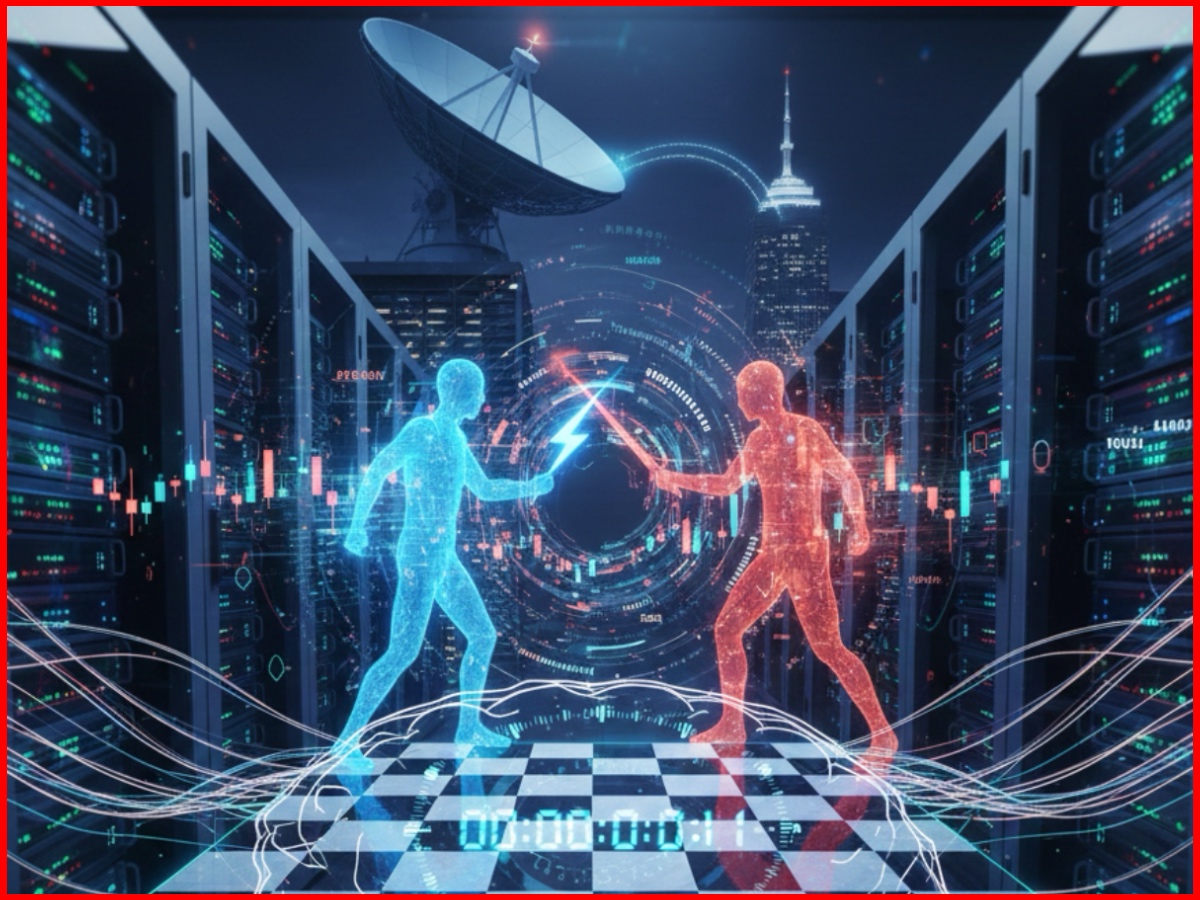
When Michael Lewis published Flash Boys in 2014, he pulled back the curtain on a hidden world where microseconds matter and speed equals power.
Nearly a decade later, the algorithmic arms race has only intensified. Today's financial markets are battlegrounds where high-frequency trading firms, institutional investors, and retail traders engage in a complex strategic game—one where understanding the rules can mean the difference between profit and loss.
The New Power Players in Modern Markets
Market microstructure—the study of how trades are executed and how prices are formed—has undergone a radical transformation. What was once a straightforward process of matching buyers and sellers has evolved into a high-tech ecosystem dominated by algorithmic traders executing millions of trades per second.
High-frequency trading (HFT) firms now account for approximately 50-60% of all equity trading volume in U.S. markets. These firms use sophisticated algorithms and cutting-edge technology to identify and exploit fleeting profit opportunities that exist for mere milliseconds. They've invested billions in infrastructure—co-locating servers next to exchange computers, building microwave networks between trading venues, and hiring teams of PhDs to develop ever-more-sophisticated strategies.
The modern market ecosystem includes market makers who provide liquidity, institutional investors managing trillions in assets, retail traders using commission-free apps, and dark pools where large trades execute away from public exchanges. Each player has different information, capabilities, and strategic objectives. Understanding these market microstructure power dynamics is essential for anyone participating in today's markets.
The Game Theory of Market Microstructure
At its core, trading is a game of incomplete information. When you place an order, you don't know who's on the other side or what information they possess. Game theory—the mathematical study of strategic decision-making—provides a powerful framework (similar to game theory for strategic asset allocation) for understanding these interactions.
In game theory terms, the market is a multi-player game where each participant makes decisions based on limited information about others' intentions and knowledge. A retail investor placing a market order doesn't know whether they're trading with a patient market maker or a predatory algorithm designed to detect and exploit uninformed order flow.
Speed as Power: The Latency Arbitrage Game
In algorithmic trading, speed isn't just an advantage—it's the foundation of entire business models. Latency arbitrage, the practice of exploiting tiny time delays between trading venues, exemplifies how speed translates directly into power and profit.
Consider this scenario: A large institutional order to buy Apple stock hits the NYSE. An HFT firm's algorithm detects this order in microseconds, instantly buys Apple shares on other exchanges where the price hasn't yet adjusted, and sells them back at a slightly higher price. The entire sequence happens faster than a human can blink, but multiplied across millions of trades, it generates substantial profits.
This speed advantage requires massive infrastructure investments. HFT firms pay premium fees to co-locate their servers in exchange data centers, shaving microseconds off execution times. Some have built private microwave networks between Chicago and New York, because microwaves travel faster through air than fiber-optic signals through glass. It's an arms race where the fastest players capture value simply by being first.
Information Advantages and Order Flow Toxicity
Beyond speed, information asymmetry creates another dimension of power. Traders with superior information—whether about fundamentals, market sentiment, or other traders' intentions—can systematically profit at the expense of less-informed participants.
This manifests in the concept of "toxic" order flow. From a market maker's perspective, some orders are more dangerous than others. An order from an informed trader who knows something the market doesn't is "toxic" because filling it likely means losing money. An order from an uninformed trader executing for non-strategic reasons is "non-toxic" and safe to trade against.
Sophisticated algorithms have become remarkably adept at distinguishing between toxic and non-toxic order flow. They analyze order characteristics—size, timing, aggressiveness—to infer whether the trader possesses superior information. When they detect toxic flow, they widen spreads or withdraw liquidity. When they detect non-toxic flow, they eagerly provide liquidity and capture the spread.
Power Dynamics in the Order Book
The order book—the electronic ledger of all buy and sell orders—is where power dynamics in financial markets play out in real-time. Quote stuffing and spoofing are controversial tactics that exemplify this manipulation. Quote stuffing involves flooding the market with thousands of orders that are quickly canceled, creating "noise" that can slow down competitors' systems. Spoofing involves placing large orders with no intention of executing them, creating a false impression of supply or demand.
While regulators have cracked down on egregious forms of these practices, those with the fastest systems can place and cancel orders faster than others can react, giving them effective control over the information displayed in the order book.
The Principal-Agent Problem in Execution
A less visible but equally important power dynamic involves the routing of retail orders. When you place a trade through a commission-free brokerage app, you might assume you're getting the best possible execution. The reality is more complex.
Most retail brokers sell their order flow to wholesale market makers through payment for order flow (PFOF). These market makers pay brokers for the right to execute retail orders, typically providing price improvement over the public exchange quote.
This creates a principal-agent problem. The broker's incentive is to maximize payment for order flow, not necessarily to get you the best execution. While regulations require "best execution," the definition is murky. The "free" trading revolution has obscured these dynamics. When brokers eliminated commissions, they didn't eliminate the cost of trading—they just made it invisible through wider spreads and less favorable execution prices.
Strategic Implications for Investors
Recognizing these power dynamics doesn't mean investors are helpless. By understanding the game being played, you can adopt strategies that minimize your disadvantages.
First, recognize that execution costs extend far beyond commissions. The bid-ask spread, price impact, and adverse selection all contribute to your total trading costs. For larger trades, these hidden costs often dwarf the explicit commission.
Second, consider your order types carefully. Market orders prioritize speed over price, making them vulnerable to adverse selection. Limit orders give you price control but risk non-execution. More sophisticated order types can help minimize information leakage and price impact.
Defensive Strategies Against Algorithmic Predation
Timing matters more than most investors realize. The market open and close see the highest volume and widest spreads, making them expensive times to trade. Mid-morning and mid-afternoon often offer better liquidity and tighter spreads for patient traders.
For larger institutional orders, dark pools—private exchanges where orders aren't publicly displayed—allow large trades to be executed without revealing intentions to the broader market. Smart order routing technology analyzes real-time conditions across multiple exchanges to find the best execution.
Perhaps most importantly, adjust your strategy to your information position. If you're trading based on public information or for non-informational reasons, you're at an inherent disadvantage. In these situations, strategic patience as an evolutionary edge often outperforms active trading.
The Regulatory Game: Rules, Enforcement, and Market Design
Market structure isn't fixed—it's the product of regulatory choices that are constantly being debated and revised. From a game theory perspective, regulation changes the rules of the game, altering the strategies that succeed and the distribution of power among players.
The SEC has implemented various rules aimed at promoting fair and orderly markets. Regulation National Market System (Reg NMS) was designed to ensure investors get the best available prices across all exchanges. Circuit breakers pause trading during extreme volatility to prevent flash crashes.
Recent enforcement actions show regulators taking market manipulation seriously. The SEC has brought numerous cases against traders engaged in spoofing and layering, imposing substantial fines and even criminal penalties. Looking forward, market structure reform remains a live issue, with proposals ranging from banning PFOF to implementing frequent batch auctions that would eliminate the advantage of being fastest.
Conclusion: Navigating the Algorithmic Battlefield
Modern financial markets are complex strategic environments where power derives from speed, information, and strategic sophistication. High-frequency traders and algorithmic market makers have built formidable advantages through massive technology investments and game-theoretic strategy design.
But understanding the game is the first step toward playing it more effectively. By recognizing how information asymmetry, adverse selection, and order flow dynamics work—applying a first principles approach to finance, investors can make smarter decisions about when, how, and where to trade.
Take a hard look at your own trading practices. Are you paying attention to execution quality, or just commissions? Are you using order types strategically? Are you applying strategic thinking in financial planning? Are you trading at optimal times? Small improvements in execution can compound into significant performance differences over time. In the game of market microstructure, knowledge truly is power.



Comments
Post a Comment