The Sovereign Investor:
Strategic Patience as an Evolutionary Edge
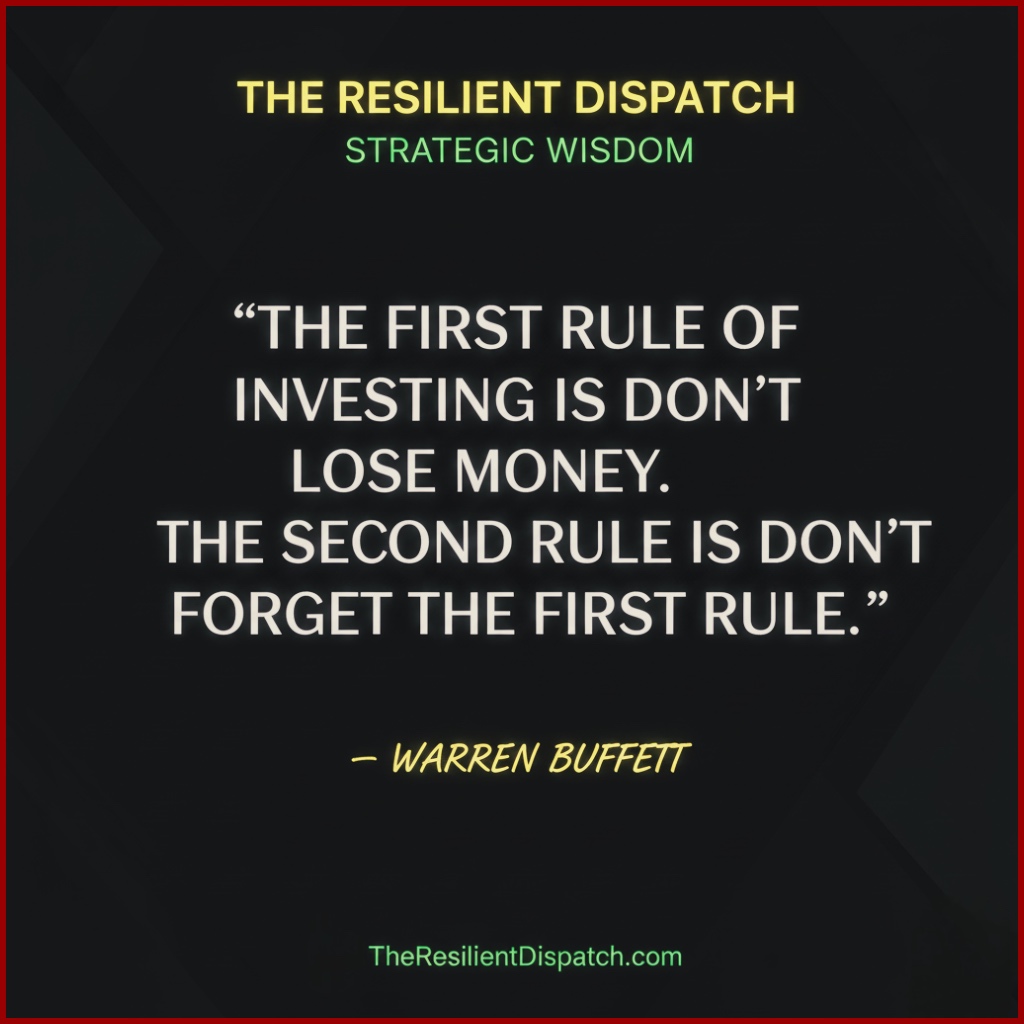
In the theater of global finance, the stock market is often mistaken for a casino. In truth, it is a living, adaptive system governed by psychology, competition, & the pursuit of power.
To the inexperienced, markets evoke fear and confusion; to the resilient, they serve as engines of wealth redistribution.
As Warren Buffett observed, the market transfers money from the impatient to the patient. But to understand why, we must look beyond charts and tickers into the logic of Game Theory — and the timeless strategies found in The 48 Laws of Power.
I. The Law of Simplicity: Reducing Surface Area for Error
Rule 1: Keep it Simple.
In Game Theory, “noisy” strategies — those with too many moving parts — collapse under their own complexity. Every added derivative, rumor, or “hot tip” expands your exposure to entropy.
Applying Law 19 (Know Who You’re Dealing With), the retail investor must recognize their adversaries are high-frequency algorithms and institutional giants. You cannot out-calculate a machine, but you can out-simplify it. By focusing on clarity and minimizing noise, you exit a game you’re designed to lose and enter a slower, endurance-based game where patience is your edge.
II. Diversification: The Nash Equilibrium of Survival
Rule 2: Diversify.
Diversification is the financial form of the Minimax strategy — minimizing the maximum possible loss. Because the future is unknowable, concentrating on a single bet is a zero-sum gamble against time itself.
By spreading across assets, you approximate a Nash Equilibrium — a position where no single reallocation can improve your outcome without insider knowledge. In the language of Law 18 (Do Not Build Fortresses to Protect Yourself), isolation is fragility; integration is protection.
III. Information Asymmetry: Research as a Shield
Rule 3: Do Your Research.
Laws 3 and 4 (Conceal Your Intentions; Always Say Less Than Necessary) are playbooks for market manipulators. A “hot tip” is rarely a favor — it’s often bait for exit liquidity.
To be resilient, invert the flow of information. Always investigate before you invest. Research transforms you from speculator to sovereign owner. It strips away hype and reveals the business’s first principles: its cash flow, moat, and long-term viability.
IV. The Inversion of Loss: Strategic Surrender
Rule 4: Know When to Let Go.
Many investors surrender to the sunk cost fallacy, holding losers to protect ego over logic. Law 47 (Do Not Go Past the Mark You Aimed For) reminds us that victory has limits; wisdom lies in restraint.
Resilient investors cut losses early and redirect resources where growth is probable. They treat their portfolios like gardens — pulling weeds without hesitation and watering flowers for decades.
V. Intellectual Compounding: The Long Game
Rule 5: Read Books.
Knowledge compounds faster than capital. Reading The Intelligent Investor or A Random Walk Down Wall Street isn’t ritual — it’s strategic scaffolding.
Law 41 (Avoid Stepping into a Great Man’s Shoes) advises charting your own path, yet Game Theory suggests imitation of successful “tit-for-tat” strategies. Books are the historical simulations that allow you to detect greed and fear cycles before they manifest again.
VI. Emotional Sovereignty: Defeating the Reptilian Brain
Rule 6: Control Your Emotions.
Markets are driven by fear and greed — the same primal impulses that shape human evolution. In Game Theory terms, the “impatient” operate in short-term games, surrendering capital to those who play infinitely.
Resilient investors master emotion before emotion masters them. Law 28 (Enter Action with Boldness) applies here: true boldness in a crash — buying when others panic — comes only from internal control.
VII. The Patient Arbitrage: Buy and Hold
Rule 7: Buy and Hold.
Patience is not passive; it is a weaponized form of discipline. The patient outlast the impulsive because time amplifies calm conviction.
Law 35 (Master the Art of Timing) teaches that timing defines all outcomes. When you hold through volatility, compounding becomes your ally. You cease trading time for money and start trading patience for the mistakes of those who couldn’t wait.
The Resilient Dispatch Summary
The stock market is the only marketplace where falling prices cause panic — where assets go “on sale” and crowds run for the exits. By following these seven rules, you don’t just invest; you evolve. You become the sovereign of your own financial destiny.
Frequently Asked Questions: The Sovereign Investor
1. Is "Buy and Hold" still viable in a high-volatility market?
From a First Principles perspective, volatility is merely the price of admission for superior returns. In an infinite game, short-term fluctuations are "noise" that the resilient investor ignores. By holding, you avoid the "haste tax" paid by impatient players who exit the game prematurely. As long as the underlying business maintains its competitive moat (Law 18), holding remains the most logically consistent path to wealth.
2. How do I know when a "hot tip" is actually a trap?
Apply Law 3 (Conceal Your Intentions). Most market participants who share tips are looking for "exit liquidity"—they need someone to buy the stock so they can sell theirs at a profit. If you cannot explain the company's value proposition using your own research (Rule 3), you are the "pawn" in someone else's game. True sovereign investors move only when they have a clear informational advantage.
3. What is the "Nash Equilibrium" of a personal portfolio?
In Game Theory, a Nash Equilibrium is reached when you have a strategy that you wouldn't change, even if you knew exactly what everyone else was doing. In investing, this is achieved through proper diversification (Rule 2). Your portfolio is at equilibrium when it is resilient enough to survive a market crash in one sector while capturing growth in another, ensuring your survival regardless of the market's next move.
4. How much "research" is enough before making a move?
The goal of research is not to know everything, but to identify the First Principles of a business's success. Focus on three variables: free cash flow, debt-to-equity ratio, and leadership integrity. If these three pillars are solid, you have enough "strategic scaffolding" to make a bold move (Law 28). Excess information often leads to analysis paralysis, which is its own form of fragility.
5. How can I master my emotions during a market panic?
Inversion is the key. Instead of asking, "How much money am I losing today?" ask, "Are the shares of these great companies currently on sale?" By shifting your perspective from a victim of the market to a predatory buyer of undervalued assets, you reclaim Emotional Sovereignty (Rule 6). Control your internal state, and you control the outcome of the game.



Comments
Post a Comment