“Press Start”
Press Start: The Architecture of the Financial Reset
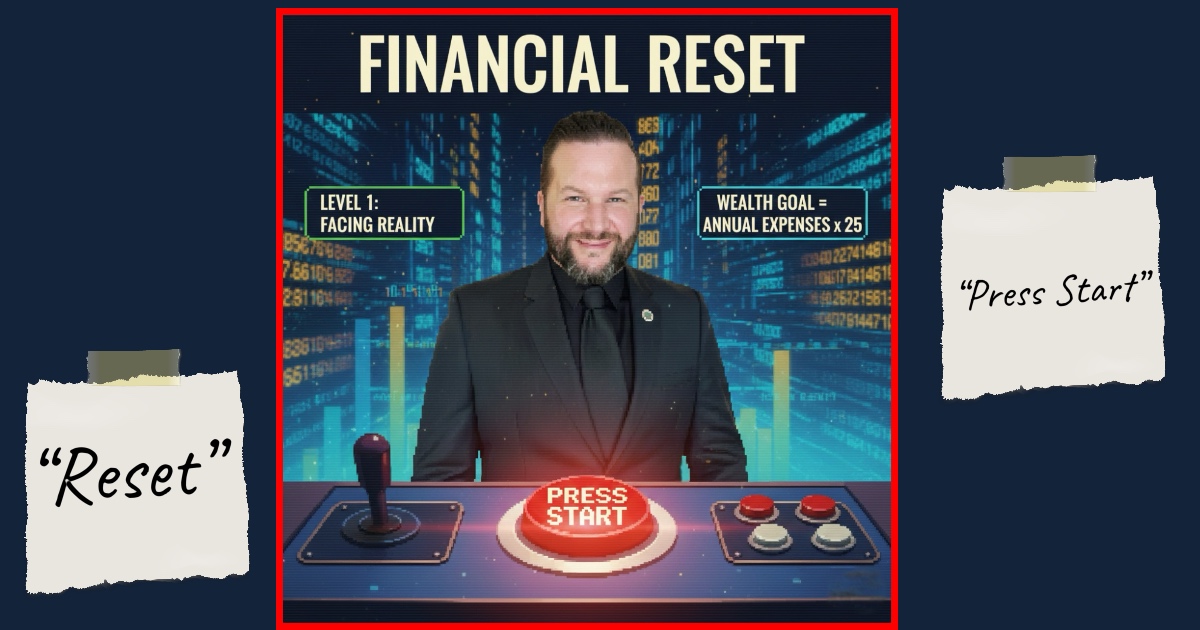
In the quiet geometry of a life rebuilt, there’s a button most people are terrified to touch. It’s the Reset button.
In our culture, “starting over” is often whispered about like a tragedy—a “Game Over” that signals the end of a story. But if you look at life through the lens of Game Theory, a reset is often the only move that makes sense. It’s the moment you stop playing a losing hand and start playing the board as it actually exists.
This is the face of a strategic reset. It is the moment between the “Game Over” of the past and the “Level 1” of the future. I’m not just sharing a formula; I’m sharing a blueprint I am currently using to rebuild from the baseline up—with scalable and significantly positive effects thus far.
I call this philosophy Press Start.
As an Architect of Resilience, I’ve realized that building wealth isn’t about the size of the house. It’s about the strength of the foundation. When you’re forced—or choose—to start over, you’re not just beginning again. You’re entering the game with the “save data” of your previous failures. You’re smarter, leaner, and more dangerous.
Facing Reality: The Stockdale Paradox
The first step of the reset is the most brutal: Facing Reality.
Most people live in a financial fog—a haze of “I’ll deal with it next month.” This is a tactical error known as the Sunk Cost Fallacy. We stay in bad investments, bad jobs, or expensive lifestyles because we’ve "already put so much in." Game theory dictates that the past is a ghost; the only thing that matters is the next move.
To Press Start, you must confront the Brutal Facts. You must look at your bank account, your debt, and your burn rate with the clinical eye of a surgeon. This is where empathy must smooth out the brutality. It’s easy to look at a zero balance and feel shame. But shame is a drain on your cognitive resources. In the Stockdale Paradox, you must maintain unwavering faith that you will prevail in the end, while simultaneously confronting the most honest version of your current situation.
The Baseline is not a pit. It’s solid ground. From here, you can finally build.
The Elegant Metric: The 25x Rule
Once the fog clears, you need a North Star. In the world of Financial Independence, the most elegant equation is the 25x Rule:
Wealth Goal = Annual Expenses × 25
This isn’t just a number. It’s an exit strategy. It turns the abstract concept of “being rich” into a mathematical coordinate. If you can substrate your life—stripping away the vanity and the noise—that 25x number moves closer. Every dollar you shave off your annual expenses doesn’t just save you $1 today; it removes $25 from your ultimate finish line.
That is the leverage of the Architect. You aren't chasing an infinite hoard; you are building a specific structure designed to house your freedom.
The Contraction: Substrate Spending
The Contraction is the deliberate shrinking of your financial surface area—the places where risk, temptation, and leakage can hit you. Most people expand as soon as they get a raise. They upgrade the car, the apartment, the lifestyle. That is "expanding your hit-box."
The Architect does the opposite. You substrate your spending through a Zero-Base Protocol. For one month, assume your budget is $0. Add back only the "Critical Systems": shelter, basic nutrition, and the tools required to keep your income flowing.
Every subscription, every impulse buy, every “I deserve this” moment is evaluated through one lens: “Does this move me toward the 25x goal, or away from it?” You are dropping the heavy, low-stat armor of "stuff" so you can move faster through the higher levels of wealth.
Stabilize and Eliminate: The War on Bad Debt
In the architecture of resilience, Bad Debt is a structural defect. You cannot "Press Start" on a new game while the old game is still draining your health bar. Debt is the "corrupted save file" that must be repaired before you can progress.
Phase 1: Stabilization.
Before you can eliminate debt, you must stop it from growing. Use Law 48: Assume Formlessness when dealing with creditors. Present the brutal reality: you are restructuring. Negotiate for lower rates or move high-interest balances into "Holding Cells" like 0% balance transfer cards. The goal is to stop the interest bleed.
Phase 2: The Elimination Strike.
Once stabilized, use your "Substrate Surplus" as ammunition. Whether you use the Avalanche Method (mathematically superior) or the Snowball Method (empathy-led quick wins), the mandate is the same: eliminate the principal with the cold efficiency of an algorithm. Once the debt is zero, your defensive perimeter is secure.
The Strategy: Law 25 and the Power of Formlessness
To protect this new build, we must employ the Laws of Power. Specifically, Law 25: Re-create Yourself. Starting over is your chance to shed the “skin” of a consumer and adopt the “mask” of the Architect.
Assume a form of Formlessness (Law 48). When you are in a reset, do not signal your moves to the market. The world expects you to maintain your "old form." By becoming formless, you stop being a target for others' expectations. You build in silence. In Game Theory, we call this an Iterated Game. You’re no longer playing for social approval; you’re playing for a Nash Equilibrium—a state where your financial position is so stable that no outside force can easily disrupt it.
The High-Yield Shelter: Building the Fortress
As you contract and eliminate debt, your surplus must be guarded. In 2025, the market is a landscape of volatility. Your “War Chest” belongs in a High-Yield Money Shelter.
Whether it’s a Money Market Fund or a 4.25% HYSA, this is your Fortress. This is where the math becomes empathetic. Seeing that monthly interest payment—no matter how small—is a “Level Up.” Even if your first payment is only $5, that is $5 of your life that has been bought back. This shelter provides:
- Liquidity: The ability to pivot when the market shifts.
- Safety: A psychological buffer against chaos.
- Momentum: Tangible proof that your money is now your employee.
New Game Plus: The Architect’s Mandate
Pressing Start is an act of supreme agency. It’s the realization that while you cannot control the economy, the interest rates, or the job market, you can control your Compliance to your own rules.
I’m putting myself in the frame because accountability is the ultimate Game Theory play. When you make your goals public, you increase the "cost" of failure, which paradoxically makes success more likely. By making the goal public, you turn your future self into a player with higher stakes—making it harder to defect from your own rules.
You are the Architect. You are the Player. The “Game Over” screen was just a tutorial designed to teach you how the mechanics of life actually work.
The fog has lifted. The board is set. The buttons are lit.
Press Start.




Comments
Post a Comment