Weaponized Finance: How Geopolitical Chess Reshapes Wealth
Weaponized Finance: How Geopolitical Chess Is Reshaping Your Wealth Strategy
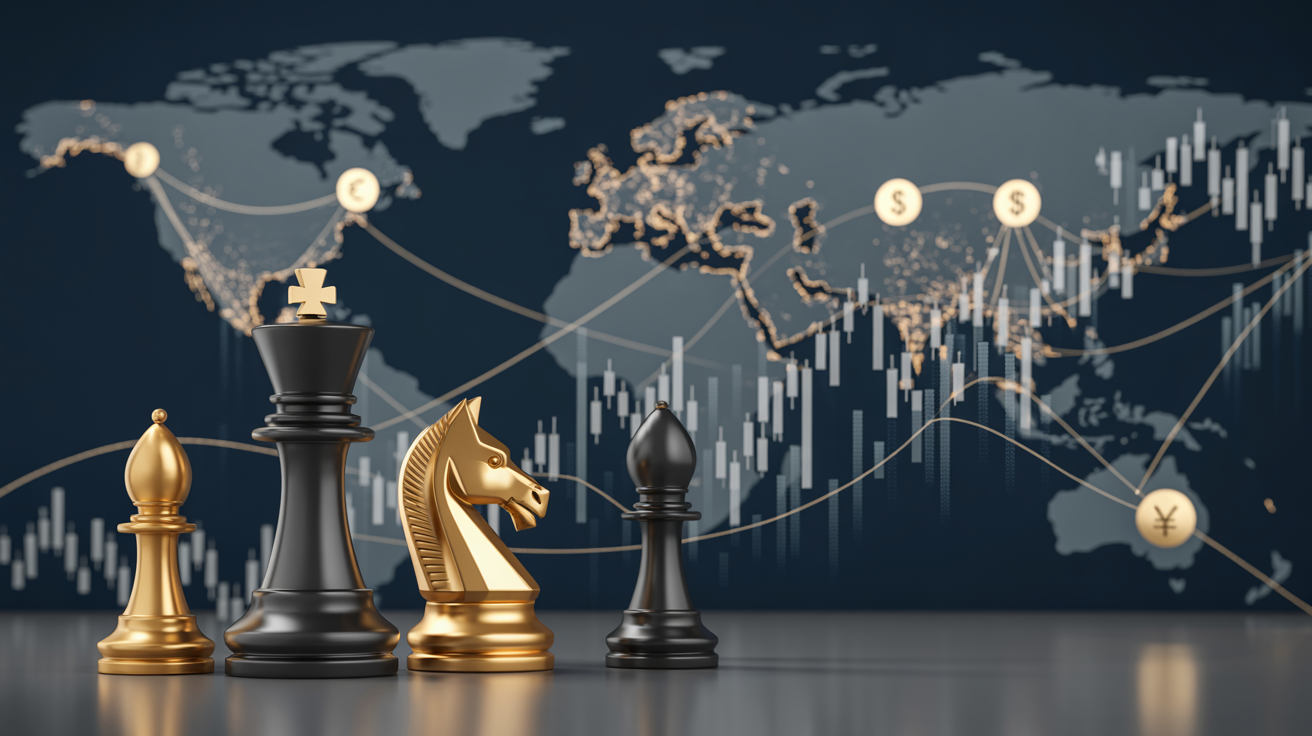
A single executive order. A SWIFT disconnection. A semiconductor export ban. These aren't just headlines — they're financial weapons, and they can vaporize portfolio value faster than any earnings miss. Welcome to the era of weaponized finance, where the most powerful players on the board aren't hedge funds or central banks. They're nation-states.
If you're still building wealth using only traditional frameworks — earnings multiples, interest rate cycles, sector rotation — you're playing checkers on a chess board. The rules have changed. Understanding how geopolitical power moves translate into market moves is no longer optional for serious wealth builders. It's the edge.
What Is Weaponized Finance?
Weaponized finance is the strategic use of financial infrastructure — currencies, payment networks, sanctions, asset freezes — by state actors to achieve foreign policy goals without firing a single shot. It's economic warfare dressed in the language of policy.
The toolkit is formidable:
- Currency dominance: The U.S. dollar comprises nearly 60% of global foreign exchange reserves. Any transaction cleared in dollars — even between two foreign entities — passes through U.S. correspondent banks, giving Washington extraterritorial reach.
- SWIFT exclusion: Cutting a country off from the Society for Worldwide Interbank Financial Telecommunication (SWIFT) messaging system effectively freezes its ability to conduct international trade.
- Asset seizure: When money is a digital ledger entry, controlling the architecture means controlling the assets. Russia learned this in 2022 when its central bank's foreign reserves held abroad were frozen overnight.
- Export controls: Restricting access to critical technologies — semiconductors, AI chips, advanced manufacturing equipment — can cripple an adversary's industrial capacity for years.
The 2022 Russia sanctions were a watershed moment. Seven major Russian banks were cut from SWIFT, the ruble collapsed, and capital fled. But the move also sent a message to every other nation watching: your reserves are only as safe as your geopolitical alignment. The weaponization of financial systems as coercive tools is now a permanent feature of the global order — not an exception.
The Game Theory Framework: Why Escalation Is Rational (Even When It's Destructive)
Here's what makes weaponized finance so dangerous and so persistent: the game theory underlying it creates escalation spirals even when no one wins.
Think of the U.S.-China trade relationship as a classic Prisoner's Dilemma. Both sides would benefit from open trade. But each side fears that if it cooperates while the other defects — by subsidizing domestic industries, restricting exports, or building parallel financial systems — it will be left strategically vulnerable. So both sides defect. Tariffs rise. Export controls tighten. Supply chains fracture.
The result? A Nash Equilibrium where both players are worse off than they would be under full cooperation, but neither has an incentive to unilaterally back down. U.S. tariffs on Chinese semiconductors have reached 25% and climbing. China has responded with export restrictions on rare earth minerals it processes at near-monopoly scale — controlling roughly 60% of global lithium processing, 70% of cobalt, and virtually all refined natural graphite.
This isn't irrational behavior. It's the cold logic of a multi-player, iterated game where credible commitment matters more than short-term efficiency. Nations are signaling that they will absorb economic pain to protect strategic leverage. Investors who understand this dynamic can anticipate where the next flashpoints will emerge — and position accordingly.
The Prisoner's Dilemma of Decoupling
Decoupling — the deliberate separation of economic interdependencies between rival powers — is expensive, disruptive, and widely understood to reduce global efficiency. Yet it continues to accelerate. Why? Because in a world where financial infrastructure can be weaponized, interdependence is also vulnerability. The rational move, from a game theory perspective, is to reduce exposure even at significant cost. For investors, this means the decoupling trend is structural, not cyclical. It won't reverse with the next trade deal.
Strategic Assets: The New Chessboard
Three categories of assets have become the primary terrain of geopolitical competition. Each one has direct implications for your portfolio.
1. Semiconductors and Technology
Taiwan produces 90% of the world's most advanced semiconductors. That single fact is one of the most consequential geopolitical realities of our time. The U.S. CHIPS Act and the EU's European Chips Act represent multi-billion dollar bets on reshoring production — but building new fabrication plants takes years and billions. In the interim, the supply chain remains a flashpoint. Export controls on advanced AI chips are already reshaping the competitive landscape between U.S. and Chinese tech firms.
2. Energy and Critical Minerals
The energy transition hasn't eliminated energy geopolitics — it's transformed it. Solar panels, wind turbines, and EV batteries require lithium, cobalt, manganese, and rare earth elements. China dominates the processing of nearly all of them. This creates a new category of chokepoint risk that didn't exist a decade ago. Meanwhile, AI data centers are driving surging electricity demand, making energy infrastructure — pipelines, grids, nuclear capacity — strategically valuable again.
3. Data and Financial Infrastructure
Dollar-backed stablecoins are quietly becoming a new instrument of U.S. financial soft power, extending dollar dominance into digital asset markets. At the same time, China's Cross-Border Interbank Payment System (CIPS) and Russia's SPFS are building parallel financial rails designed to reduce dependence on Western-controlled infrastructure. The battle for control of payment architecture is a long game — but it's already underway.
What This Means for Your Portfolio
The shift from a globalized, rules-based financial order to a fragmented, multipolar one requires a fundamental update to how you think about risk and opportunity. Here's a practical framework:
1. Diversify across geopolitical blocs, not just asset classes.
Traditional diversification — stocks, bonds, real estate — doesn't protect you if an entire geopolitical bloc faces sanctions or capital controls. Think about exposure across U.S.-aligned, China-aligned, and genuinely neutral markets (Vietnam, India, UAE, Mexico).
2. Overweight "chokepoint" sectors.
Defense contractors, domestic semiconductor plays, energy infrastructure, and cybersecurity firms are direct beneficiaries of the weaponized finance era. NATO members have committed to raising defense spending targets — potentially to 5% of GDP by 2035 — creating a sustained tailwind for defense-oriented investments.
3. Monitor dollar dominance signals.
Watch central bank reserve diversification data, stablecoin adoption trends, and CIPS transaction volumes. A meaningful shift away from dollar-denominated reserves would be one of the most significant macro events of the decade. Gold remains a relevant hedge — 2025 saw central bank gold demand at 863 tonnes, driven largely by de-dollarization concerns.
4. Use options and hedges around known geopolitical flashpoints.
Elections, diplomatic summits, sanctions announcements, and military escalations are increasingly predictable in their timing if not their outcome. Volatility tends to spike around these events. Protective puts, volatility ETFs, or simply raising cash before high-risk windows can preserve capital during the most acute phases of geopolitical stress.
For a deeper dive into specific portfolio construction strategies for a fractured world — including commodity supercycles and reshoring plays — see our earlier analysis on building wealth on the geopolitical chessboard.
The Retail Investor's Power Move
Here's the honest truth: retail investors can't match the geopolitical intelligence capabilities of sovereign wealth funds or major institutions. They have analysts, government contacts, and proprietary data feeds. You have CNBC and a brokerage account.
But retail investors have something institutions often lack: flexibility and speed. You can rotate into a thematic ETF in minutes. A $50 billion pension fund cannot. You can exit a position without moving the market. They cannot.
Practical moves for retail investors navigating weaponized finance:
- Thematic ETFs focused on defense, cybersecurity, domestic manufacturing, and critical minerals give you diversified exposure to geopolitical tailwinds without single-stock risk.
- Commodity exposure — through ETFs or commodity-linked equities — provides a natural hedge against supply chain disruptions and currency debasement.
- Domestic vs. international allocation shifts based on geopolitical risk cycles can be executed quickly and cheaply.
- Dollar-cost averaging through periods of geopolitical volatility turns market fear into a systematic buying opportunity.
The information asymmetry between institutional and retail investors is real — but it's not insurmountable. Understanding the structural forces at play, as explored in our piece on information asymmetry in the AI-augmented wealth era, is the first step toward closing that gap.
Conclusion: Play the Board, Not Just the Pieces
The investors who will build lasting wealth in this environment are those who understand that financial markets are now embedded in a larger geopolitical game. Earnings matter. Rates matter. But so does who controls the semiconductor supply chain, who can freeze whose reserves, and which nations are quietly building alternative financial rails.
Weaponized finance isn't a temporary disruption. It's the new operating environment. The question isn't whether geopolitics will affect your portfolio — it already is. The question is whether you're positioned to navigate it strategically, or whether you're still waiting for the board to go back to the way it was.
It won't. Audit your portfolio for geopolitical exposure. Identify your chokepoint risks. And start thinking like a strategist.


Comments
Post a Comment