The Geopolitical Chessboard: Build Wealth as Nations Play Power Games
The Geopolitical Chessboard: How to Build Wealth When Nations Play Power Games
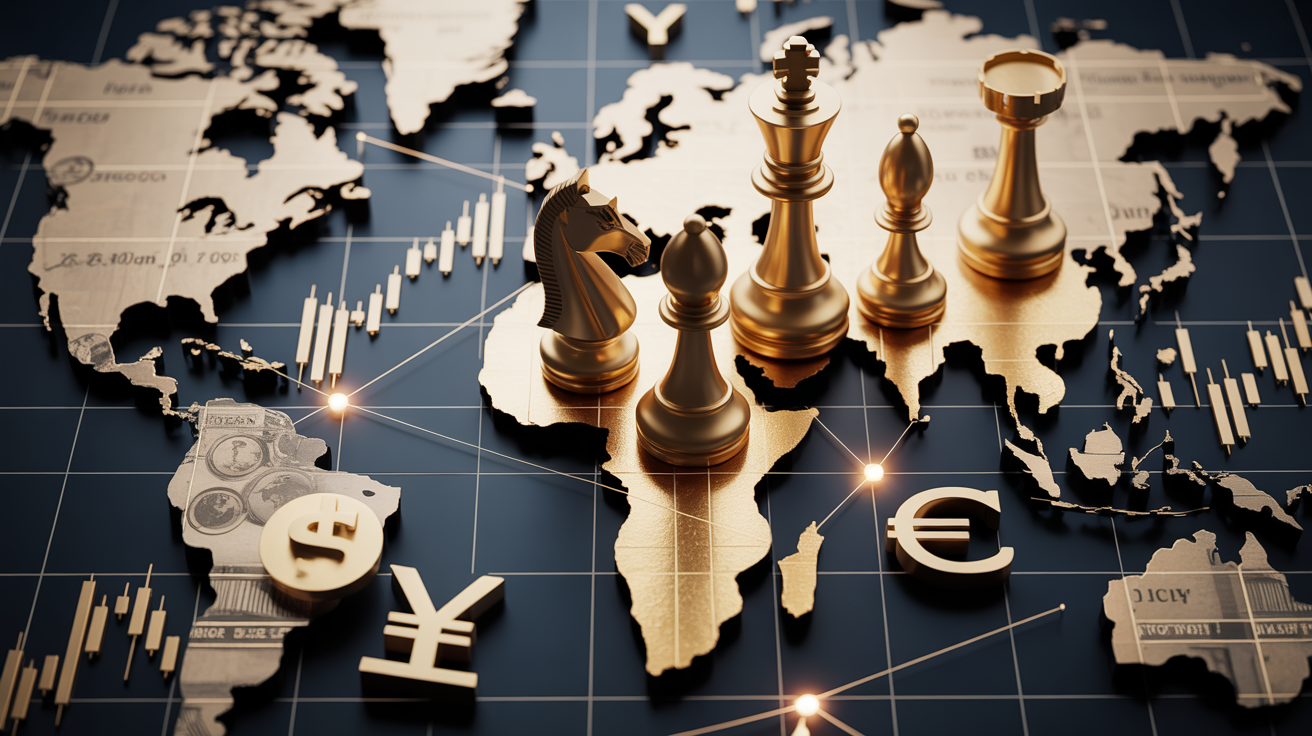
Markets don't move on earnings alone anymore. In April 2026, a single tariff announcement can reprice an entire sector overnight. A sanctions decision made in Washington or Beijing can strand billions in capital before most investors have finished their morning coffee. If your wealth-building strategy doesn't account for geopolitics, you're not playing the game — you're being played by it.
The good news: the investors who understand the logic behind these power moves — not just the headlines — are finding opportunity in the chaos. Here's how to think like a strategist, not a spectator.
Why Geopolitics Is Now the Most Important Variable in Your Portfolio
For decades, the conventional wisdom was simple: diversify across sectors, hold low-cost index funds, and ignore the noise. Geopolitical events were treated as temporary disruptions — sharp but short-lived shocks that the market would absorb and move past.
That model is broken.
The US-China trade war has escalated into something structural. As of early 2026, the US has imposed Section 232 tariffs of up to 50% on metals, a 25% tariff on advanced semiconductors, and a sweeping 10% import surcharge on all goods. Bilateral trade between the two largest economies saw its biggest collapse since 1979 — Chinese exports to the US fell 18.9% in 2025, while US exports to China dropped 13.2%. These aren't temporary disruptions. They are a permanent repricing of global supply chains.
Geopolitical risk is no longer a tail risk. It's a baseline condition. The investors who treat it as background noise will be perpetually surprised. The ones who build it into their framework will be positioned to profit.
The Game Theory of Nations — What Investors Can Learn from It
Here's where it gets interesting. Nations don't make random decisions — they make strategic ones, driven by incentives, leverage, and the moves of their rivals. That's game theory in its purest form.
Consider the trade war through the lens of the Prisoner's Dilemma: both the US and China would benefit from mutual cooperation and open trade. But because each side fears being exploited if they cooperate while the other defects, escalation becomes the dominant strategy — even when it's economically destructive for both. Understanding this logic tells you something crucial: trade tensions won't resolve quickly, because the incentive structure doesn't reward de-escalation.
The Nash Equilibrium concept is equally useful. Markets tend to price in the expected geopolitical outcome — the equilibrium that most participants anticipate. The edge for investors lies in identifying when that equilibrium is about to shift: when a new variable (a diplomatic breakthrough, a resource shock, a domestic political crisis) changes the incentive structure for one of the players.
China's control of 70% of global rare earth processing isn't just a supply chain fact — it's a strategic leverage point. Whoever controls critical inputs controls the game. Mapping these leverage points helps you predict where capital will flow before the headlines catch up. For a deeper look at the game theory dynamics that drive market behavior, the same Nash Equilibrium logic that governs high-frequency trading arms races applies directly to geopolitical power plays.
The Multipolar Playbook — Four Investment Strategies for a Fractured World
Understanding the game is one thing. Profiting from it requires a concrete playbook. Here are four strategies that sophisticated investors are deploying in 2026.
1. Commodity Supercycle Positioning
We are in what analysts are calling "Commodity Super-Cycle 2.0" — a structural, multi-year bull market in critical materials driven by the energy transition and AI infrastructure build-out. An EV uses 5–10 times more copper than a conventional car. Data centers are copper- and electricity-intensive at a scale the grid wasn't built for. Demand for lithium, cobalt, and nickel is projected to grow by 220%, 150%, and 110% respectively between 2020 and 2030.
Supply can't keep up. A new copper mine takes 10–15 years to permit and build. China controls the processing of most critical minerals. This structural scarcity — combined with geopolitical weaponization of resource access — creates a durable tailwind for commodity-linked assets: mining equities, commodity ETFs, and royalty companies that collect revenue without bearing operational risk.
2. Reshoring & Supply Chain Beneficiaries
The great decoupling is real and accelerating. The US, EU, and allied nations are spending trillions to rebuild domestic manufacturing capacity — semiconductors, pharmaceuticals, industrial automation, and logistics infrastructure. This isn't a political talking point; it's a capital allocation decision backed by legislation and national security mandates.
The beneficiaries are the companies building the factories, the robots that run them, and the infrastructure that connects them. Industrial automation, domestic semiconductor fabrication, and logistics technology are sectors with structural tailwinds that don't depend on geopolitical détente — they benefit from continued tension.
3. Currency & Gold as Geopolitical Hedges
Central banks are sending a clear signal: they don't fully trust the dollar-dominated financial system. In 2025, central banks purchased a net 863 tonnes of gold — more than double the 2010–2021 annual average of 473 tonnes. The World Gold Council forecasts approximately 850 tonnes of central bank buying in 2026. The primary driver? De-dollarization and the desire for a sanction-proof reserve asset after the 2022 freezing of Russian reserves served as a wake-up call for non-allied nations.
When price-insensitive sovereign buyers are accumulating gold at record rates, they create a structural price floor. Dips become buying opportunities for central banks trying to hit allocation targets — which means retail investors who understand this dynamic can position accordingly. According to World Gold Council data on central bank gold demand, this trend shows no signs of reversing.
4. Geopolitically Neutral Markets
Not every country is a combatant in the new cold war. Some are beneficiaries of it. Vietnam, India, Mexico, and the UAE are attracting manufacturing investment and capital flows precisely because they're not caught in the crossfire between the US and China. They offer the labor costs and growth potential of emerging markets without the direct geopolitical exposure.
These "Switzerland" markets can be accessed through country-specific ETFs and American Depositary Receipts (ADRs), giving investors targeted exposure without the complexity of direct foreign investment.
The Psychological Edge — Staying Rational When the Headlines Scream
Here's the uncomfortable truth: the biggest threat to your geopolitical investment strategy isn't the geopolitics. It's your own psychology.
Research on investor behavior during crises consistently identifies the same culprits: herd behavior (selling because everyone else is selling), loss aversion (the pain of a loss feels twice as intense as the pleasure of an equivalent gain), and availability bias (constant news coverage makes a crisis feel more catastrophic than it is). These biases cause investors to defect — to panic-sell — at exactly the moment when strategic patience would be most rewarded.
The investors who stayed disciplined during the 1973 oil embargo — when the S&P 500 fell over 40% — and held through the recovery captured the powerful bull market of the 1980s. The ones who panic-sold locked in losses and missed the rebound.
The game theory insight here is powerful: most retail investors will defect under pressure. That predictable behavior creates opportunity for those who don't. The framework for avoiding this trap is second-order thinking: don't ask "what will happen?" Ask "what will most investors do when this happens, and how can I position ahead of that reaction?" This connects directly to the broader question of how nations weaponize finance against investors — and why pre-planned responses beat reactive ones every time.
Pre-set your rules before the crisis hits. If X geopolitical event occurs, I will do Y — not because I'm reacting to headlines, but because I've already thought through the scenario.
Building a Geopolitically Resilient Portfolio — A Practical Framework
Resilience doesn't mean abandoning diversification. It means layering geopolitical awareness on top of a sound foundation. A practical three-layer model:
- Core (60%): Diversified, low-cost index funds. This is the foundation that weathers most storms and captures long-term market growth. Don't abandon it for geopolitical speculation.
- Tactical (25%): Geopolitical theme plays — commodity-linked assets, reshoring beneficiaries, and exposure to neutral-market economies. These positions are reviewed quarterly, not daily.
- Hedge (15%): Gold, short-duration bonds, cash, or volatility instruments. This layer isn't designed to generate alpha — it's designed to preserve capital and provide dry powder when dislocations create buying opportunities.
The discipline is in the rebalancing. Reassess your tactical and hedge layers quarterly, aligned with major geopolitical developments — not in response to every news cycle. Reactive rebalancing is just panic-selling with extra steps.
The Long Game — Why Patient Capital Wins in a Multipolar World
Geopolitics is the ultimate long game. The nations and companies that control critical infrastructure, scarce resources, and essential technology will compound wealth over decades — regardless of which administration is in power or which trade deal gets signed or torn up.
History is unambiguous on this point. Investors who stayed strategic through the Cold War, the 1970s oil shocks, and the post-9/11 volatility were rewarded. Not because they predicted every move on the chessboard, but because they understood the structural forces at play and positioned accordingly — then had the discipline to hold.
The multipolar world isn't a problem to be solved. It's a condition to be navigated. And for investors who think like strategists, it's one of the most target-rich environments in a generation.
The board is set. The pieces are moving. The only question is whether you're playing — or being played.


Comments
Post a Comment