The Sovereign Rebirth: A First Principles Fix for America’s $38 Trillion Debt Crisis
America’s national debt has surged to $38.42 trillion as of early 2026. That’s not just an accounting problem—it’s a test of imagination.
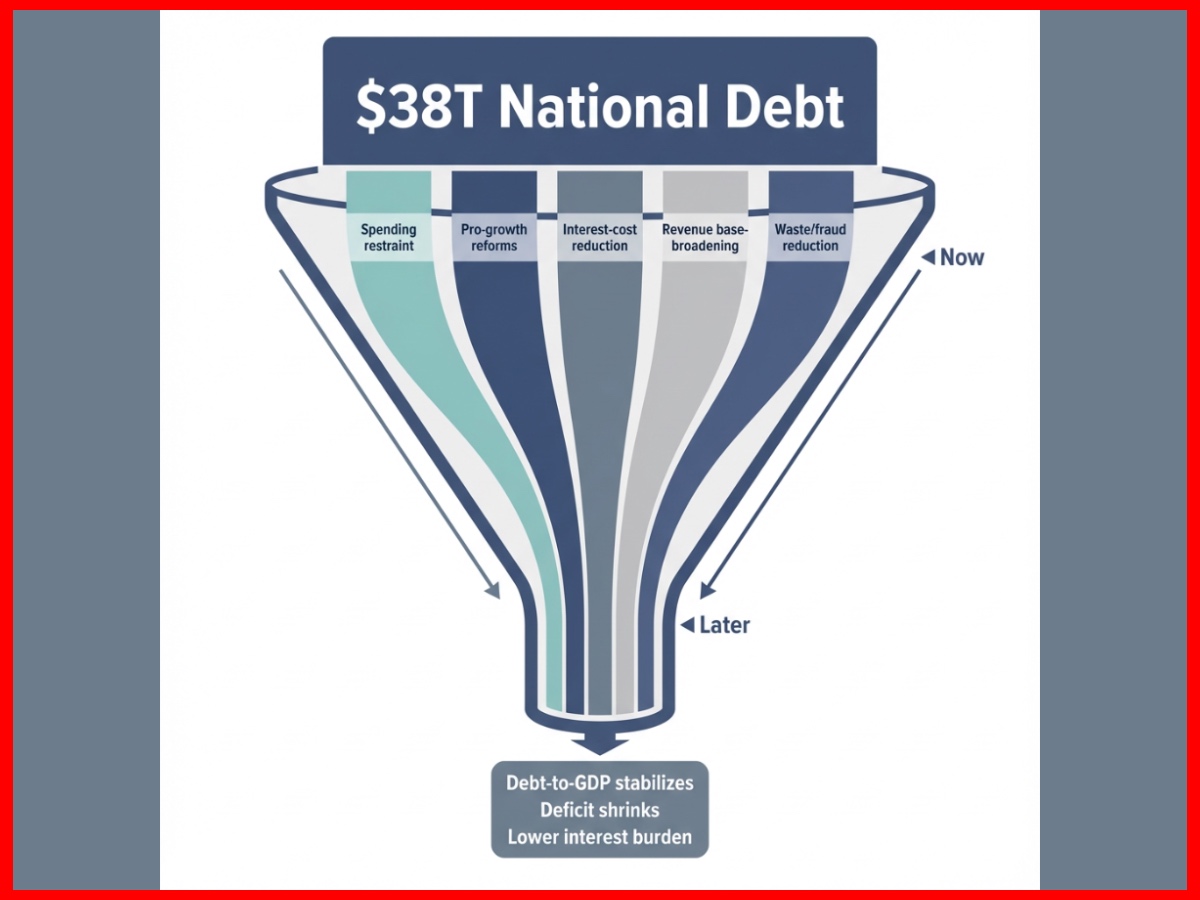
This moment demands we go beyond partisan finger-pointing and rethink the Republic from first principles. The goal isn’t simply to “repay the debt,” but to render it irrelevant—by turning America into a high-performing, self-reinforcing growth engine.
Drawing from game theory, AI economics, and the laws of power, this blueprint reframes the United States as the world’s most sophisticated turnaround project. Instead of austerity, we pursue acceleration—outpacing debt through strategic investment, innovation, and intelligent leverage.
Table of Contents
I. First Principles: Reimagining the Nation-State
At its core, a nation-state is a capital allocator with a monopoly on violence and currency. Yet America misallocates both power and resources, channeling trillions into liabilities—bureaucratic bloat, fraud, and over $1 trillion in annual interest, now outpacing defense spending.
- The Core Problem: We spend $7 trillion a year, much of it on depreciating assets. Entitlements like Social Security and Medicare are projected to top $3 trillion by 2030, threatening fiscal gridlock.
- The Grand Inversion: The right question isn’t “How do we pay it back?” but “How do we make it trivial?” If national asset returns exceed debt costs (currently 4–5%), growth outruns gravity.
- Strategic Growth: By leveraging AI-driven productivity—already adding 3–4% to GDP—we target 5–7% sustainable annual growth.
Human Capital Index: Launch a $100 billion AI-skills fund that treats citizens as appreciating assets, generating 2–3x ROI in workforce output. This isn’t welfare—it’s future-proofing America’s productivity base.
II. Game Theory Unleashed: Monetizing Global Security
The U.S. spends nearly $1 trillion a year on global security—defending trade routes, undergirding NATO, and ensuring global liquidity. Yet most allies free-ride, a textbook “Sucker’s Payoff” from game theory.
- Power Principle: As Robert Greene teaches, never solve others’ problems for free—it breeds dependence.
- The Security Dividend: Require allies to hold 10–20% of reserves in U.S. Treasuries at capped 3% yields. With foreign holdings now near $9 trillion, this policy hardwires reciprocity.
- The Nash Equilibrium: Allies gain guaranteed protection; the U.S. gains loyal debt buyers. Tier participation: Core Allies (NATO/Five Eyes) at 10–20%, Peripherals (Saudi Arabia, Vietnam) at 5–10%. Tie access to defense tech or tariff advantages.
III. The AI Audit: Eradicating Waste and Unlocking Assets
Every empire collapses from internal bleed, not external invasion. Washington leaks $200–500 billion annually through fraud and duplication.
- Audit Revolution: Deploy LLM-powered auditors to comb every line item, eliminating “zombie” programs. A new Department of Government Efficiency (DOGE) reclaims billions without austerity.
- Asset Overhaul: The federal government owns 640 million acres—about 28% of U.S. land. Sell or lease the bottom 10% of non-strategic holdings via transparent digital auctions, generating $100–500 billion.
- Smart Recycling: Dedicate 20% of proceeds to renewable infrastructure—solar, nuclear, or hydrogen—on sold sites. Further unlock capital through FCC spectrum auctions and crypto asset conversions.
IV. The Freedom Fund: From Tax-and-Spend to Invest-and-Thrive
Instead of burning energy royalties, compound them. In FY2025, the federal take from oil, gas, and renewables was $14.6 billion, yet it went straight to expenses.
- Launch a U.S. Sovereign Wealth Fund (SWF): Seed it with 25% of energy royalties, tariff receipts ($100B+), and recovered assets. Target $1–5 trillion over time.
- Portfolio Design: Allocate 40% equities, 30% bonds, 20% infrastructure, 10% AI and emerging tech. At 7% annual returns, the fund doubles roughly every 10 years—potentially covering all interest payments by 2040.
V. The Smart Alternative to Default: Financial Repression 2.0
Some propose default as a display of power. That’s delusion. A default kills confidence—the true source of American supremacy. Instead, wield controlled financial repression: cap Treasury yields near 3% while driving 5% GDP growth through AI productivity.
Inflate debt away organically, repeating the post–WWII playbook that cut debt-to-GDP by 3–4% per year. Protect real incomes by indexing entitlements to productivity rather than inflation alone.
VI. The Principal Mandate: Pay America First
Discipline must be achieved by design. Legally sequester 10% of federal tax revenues—about $400–500 billion annually—for principal reduction. No discretion, no debate.
- Trigger Rule: Activate only when debt-to-GDP exceeds 100% (currently ~130%).
- AI Allocation Engine: Rank all federal spend by ROI, cutting the lowest-yield layers first.
- Debt Buyback Mechanism: Use Sovereign Wealth Fund profits to repurchase debt at discounts, compounding fiscal strength.
Executive Summary: A Nation as a Portfolio
Reimagine America not as a debtor, but as the ultimate prosperity platform:
- Monetize the Land: Convert idle resources into generative assets.
- Charge for the Shield: Align defense with reciprocal economics.
- Invest the Surplus: Build compounding capital through the 25% rule.
- Audit Relentlessly: Let AI delete inefficiency at scale.
- Empower People: Treat citizens as high-yield capital.
With AI as the lever and disciplined growth as the fulcrum, the U.S. can reduce debt-to-GDP to 80% within two decades—without sacrificing strength or innovation.
The time for incremental tweaks is over. This is America’s sovereign rebirth.



Comments
Post a Comment