The 737 Gambit
Game Theory and the Cold Calculus of the Skies
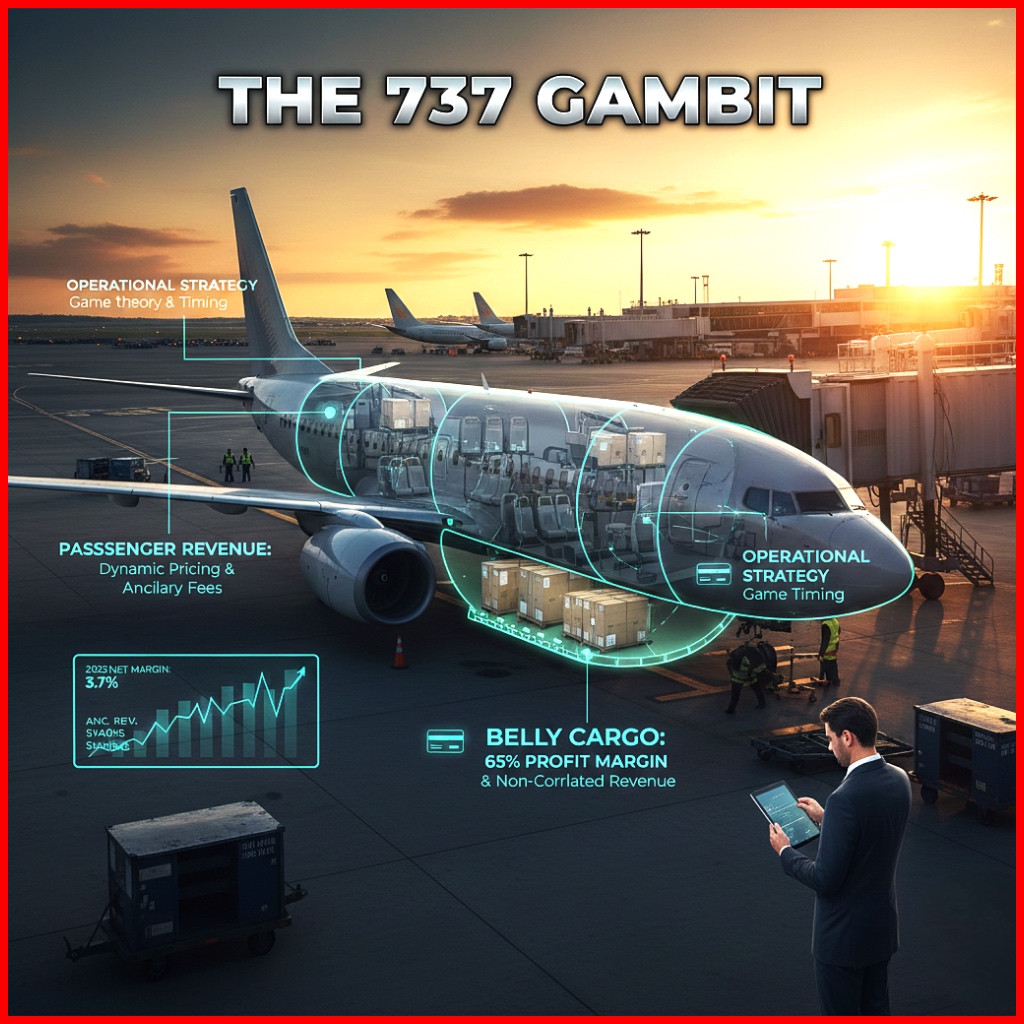
A Boeing 737 sitting idle at the gate bleeds approximately $5,500 per hour in ownership and opportunity costs.
Yet, in 2025, airlines are projected to move 5 billion passengers at prices that, adjusted for inflation, are historic lows.
To the casual observer, it is a pressurized tube; to the architect of capital, it is a $100-million asset executing a high-stakes move in a zero-sum game.
To understand how a flight makes money—or more precisely, how it defends its right to exist—requires interweaving Game Theory, the Laws of Power, and the razor-thin margins of aviation finance.
1. The Nash Equilibrium: Why 12A Paid $400 and 12B Paid $89
In the dogfight for a 737-800’s 160 seats, airlines exist in a perpetual Nash Equilibrium. If a carrier raises prices unilaterally, they lose "Load Factor" (market share) to competitors. If they lower them, they trigger a race to the bottom that destroys the industry's collective margin.
The solution is Dynamic Pricing. AI-driven algorithms simulate millions of scenarios per second to extract the maximum Consumer Surplus. This is tactical warfare: the passenger in 12A paying $400 for a last-minute business trip is subsidizing the student in 12B. With industry load factors hitting an all-time high of 84% in 2025, the calculus is clear: every seat is a variable, not a fixed commodity.
2. The Law of Power: Formlessness and the Credit Card Empire
According to the 48 Laws of Power, one must “Assume Formlessness.” Modern airlines have mastered this by transforming from transportation companies into integrated financial ecosystems.
By 2025, ancillary revenues—led by co-branded credit card partnerships—generated $144 billion. Airlines sell "miles"—a digital currency they control, inflate, and devalue at will—to banks like Chase and Amex. This revenue stream is the true seat of power. By tethering a passenger’s credit score and daily coffee habit to their brand, the airline achieves a state where the physical plane is merely a marketing vehicle for a high-margin financial product.
3. Belly Cargo: The Hidden 65% Margin
The physics of the 737-800 dictates a burn of roughly 850 gallons of jet fuel per hour. At current rates, a three-hour hop is a $3,800 fuel liability. When you factor in crew and maintenance, the "break-even" point is a staggering 80% load factor.
Belly Cargo is the silent savior. While passengers complain about legroom, the hold is filled with e-commerce and medical supplies. This revenue operates at a 65% profit margin because the passenger operation has already "paid" for the flight's departure. For many carriers, this cargo is the only reason the flight is in the black.
4. Law 35: Mastering the Art of Timing
Every minute a 737 sits on the tarmac, the "Time-Value of Money" works against the carrier. Law 35 states: Master the Art of Timing. Budget carriers like Ryanair and Southwest exercise this by utilizing a "Point-to-Point" strategy, avoiding the bottlenecks of major hubs. By turning a plane around in 25 minutes and flying it 14 hours a day, they out-calculate legacy carriers who are bogged down by prestige and complexity.
The Dispatch Verdict
Industry revenues may hit $979 billion in 2025, but net margins hover at a precarious 3.7%. Success in the skies is not about the ticket; it is about the system. It is about leveraging passenger data, bank capital, and the global supply chain’s desperation for speed.
In the end, the 737 is merely the loss leader for a much larger, invisible financial empire.



Comments
Post a Comment