The Architect’s Map: Engineering Wealth with Game Theory and Atomic Habits
The Architect’s Map: Engineering Wealth with Game Theory and Atomic Habits
Wealth is rarely the result of a single "big win." It is the inevitable outcome of reducing unforced errors, automating discipline, and compounding small advantages over time.
When you view your finances through the lens of Strategic Power and Game Theory, money stops being a source of anxiety and becomes a system you control.The Internal Architect
This is your 30-year grand strategy: a deliberate sequence of moves where foresight beats impulse.
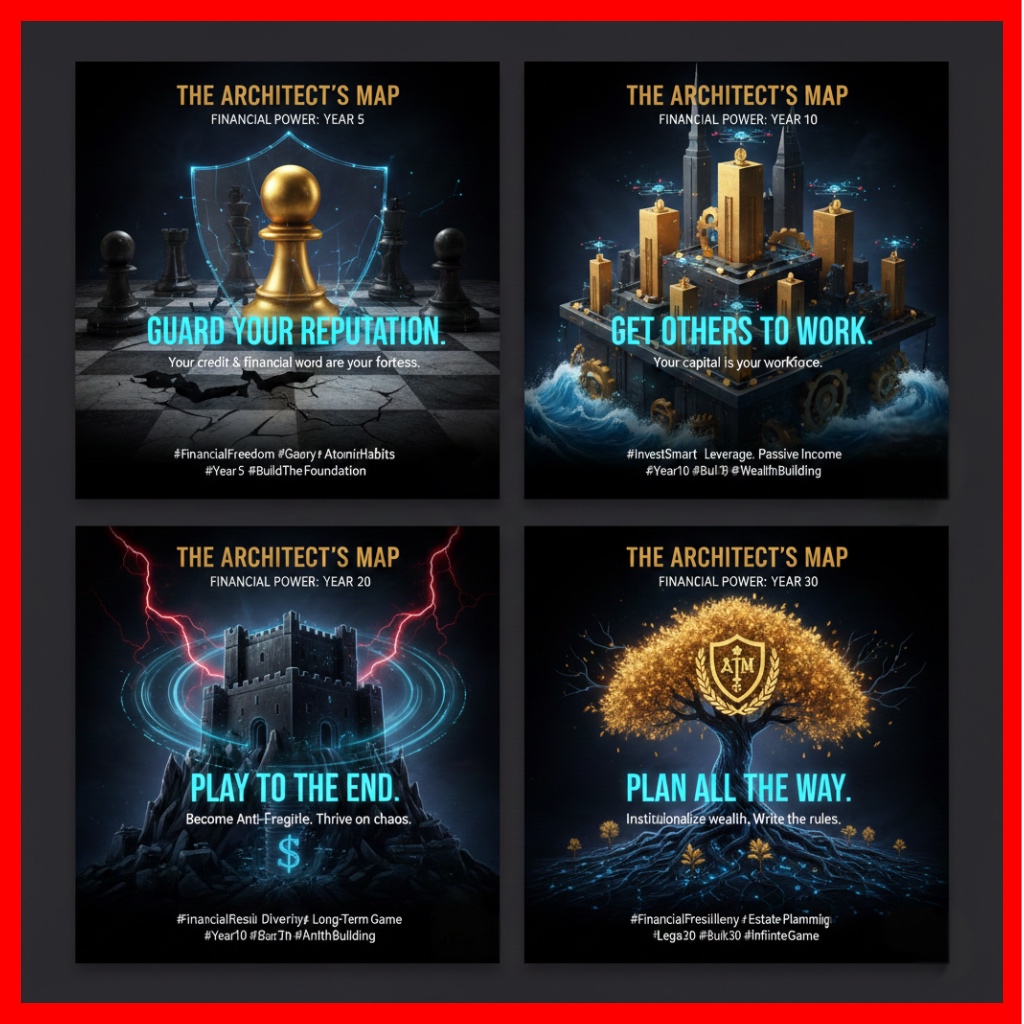
🎯 Year 5: The Foundation (Surviving the Opening Gambit)
Objective: Eliminate "ruin" as a possibility.
* Law of Power: Guard your reputation with your life. In modern terms: your credit score and financial word are your identity.
* Game Theory: Avoid zero-sum games. Stop chasing “get rich quick” plays where someone must lose for you to win. Play the infinite game of steady accumulation.
The Moves:
Automate the Baseline: Remove emotion from the equation. Set automatic transfers into investments so “saving” isn’t a monthly decision—it’s the default state of your ecosystem.
Cut Tail Risk: Eliminate high-interest debt. It is a negative-sum game that mathematically ensures you lose over time.
Atomic Habit: The Financial Autopsy. Once a week, scan every transaction. You cannot control what you do not consciously see.
🚀 Year 10: Positioning (The Power of Leverage)
Objective: Shift the weight from labor income to asset income.
* Law of Power: Get others to do the work for you. Your capital is now your workforce. Every dollar is a soldier recruited to bring back more soldiers.
* Game Theory: Build a Dominant Strategy. Structure your assets so that even in a flat market, your default state is growth via dividends, interest, and tax advantages.
The Moves:
Maximize the Match: Use every tax-advantaged vehicle (401k, IRA, HSA). Leaving an employer match unused is a dominated strategy—it is a guaranteed loss of value.
Systemic Rebalancing: Automate your portfolio rebalancing. This forces you to buy low and sell high without the psychological trap of trying to time the market.
Atomic Habit: The Annual Re-Rate. Every January, increase your automated savings rate by 1–2%. You will barely feel the lifestyle shift, but the compounding effect will be transformative.
🏛️ Year 20: Strategic Dominance (The Fortress)
Objective: Decouple your lifestyle from economic volatility.
* Law of Power: Play to the end. Ignore short-term noise and headline panic. A 20-year strategy is not broken by a 6-month recession.
* Game Theory: Reduce Fragility. Over a 20-year horizon, "Black Swan" events—recessions, shocks, disruptions—are a mathematical certainty. Design a system that survives the crash and buys the dip.
The Moves:
Diversify the Board: Move beyond a single asset class. Introduce real estate, alternative assets, or geographical diversification to protect against localized collapse.
Automate Protection: Dial in insurance, legal structures, and estate planning. At this stage, you are playing for Anti-fragility—becoming stronger because of volatility, not in spite of it.
Atomic Habit: The Stress-Test Simulation. Once a year, ask: “If my primary income disappeared tomorrow, how many years could my fortress stand?” Adjust until the answer brings you peace.
🏛️ Year 30: Legacy (The Infinite Game)
Objective: Institutionalize your wealth so it outlives you.
* Law of Power: Plan all the way to the end. True power is not just having money; it is dictating the logic of how that money functions when you are no longer here.
* Game Theory: Intergenerational Cooperation. Shift from “winning the game” to “writing the rules” for the players who follow.
The Moves:
Automate Stewardship: Use trusts and charitable vehicles with logic-based conditions (e.g., matching funds for an heir’s education or business startup).
Codify the Wisdom: Wealth without a user manual is usually gone by the third generation. Document your financial philosophy, rules, and the "why" behind the wealth.
Atomic Habit: The Legacy Audit. Review and update wills, trusts, and stewardship instructions annually to reflect changes in the world and your family’s growth.
Closing Thought
Wealth is not a prize to be won; it is a system to be designed. When you reduce bad decisions and automate discipline, financial freedom shifts from “wishful thinking” to “probable outcome,” then to near mathematical certainty.
The game is rigged in favor of those who can wait.
The only real question is: Are you playing for the next 30 days, or the next 30 years?



Comments
Post a Comment